

“I choose to learn”
How the Fiat Lux Program and Prison Education Program redefine learning at UCLA
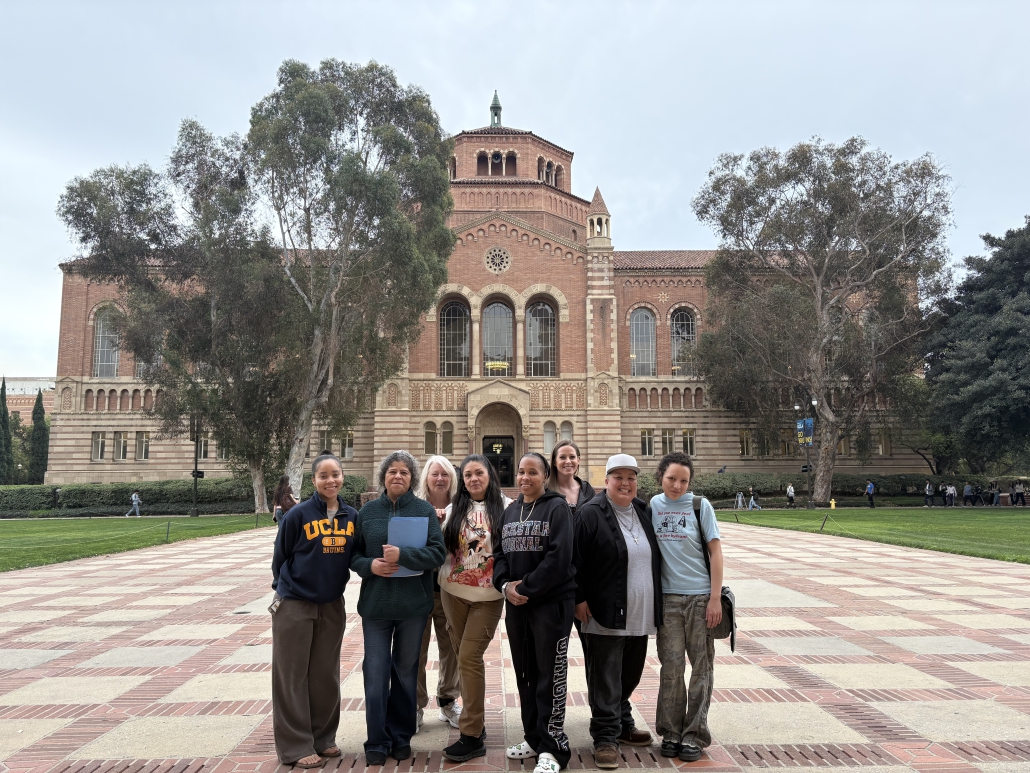
UCLA – A group of students enrolled in front of Powell Library at UCLA. During the Winter 2026 quarter, the Prison Education Program brought individuals in the Female Community Reentry Program to enroll in a UCLA course for the first time.
By Kayla McCormack
April 14, 2026
On first look, it seemed like any class at UCLA. Students discussing their days and taking their seats as class started.
Everything felt routine, except among the group were students who were living in carceral facilities.
For the first time during Winter 2026, PEP brought students from the Female Community Reentry Program (FCRP) to UCLA’s campus to take a Fiat Lux class alongside undergraduates. The FCRP is a voluntary program that places eligible incarcerated women in community-based residential facilities where they receive reentry services like housing, employment assistance, and counseling, prior to release to help support their successful reentry into community.
This course marked a milestone in the partnership between UCLA’s Fiat Lux Program and the Prison Education Program (PEP). Since 2019, the collaboration has brought UCLA students into prisons, for small, discussion-based seminars that connect incarcerated students (inside students) with non-incarcerated peers (outside students).
For Carmen Lopez, one of the FCRP students enrolled in the course, the experience has been confidence building.
“I was very nervous,” she said. “I felt intimidated, being surrounded by younger students. But now, after this class, I feel like I could go to another college and take a regular class.”
The course, “An Introduction to Trauma and Its Impact on Communities,” centers on Adverse Childhood Experiences (ACEs) — traumatic events that occur between ages 0-17 — and their lasting effects on health and well-being. It is co-taught by Dr. Shannon Thyne, director of pediatrics for the Los Angeles County Department of Health Services, and her colleagues at the UCLA-UCSF ACEs Aware Family Resilience Network, Emily Williams, Amy Shekarchi, and Nina Thompson.
‘We all have stories to tell’
The students’ diverse lived experiences led to impactful conversations throughout the course.
“There’s a camaraderie that’s developed allowing both inside and outside students to find this common space,” Thyne said.
That is in part, because trauma isn’t limited to certain demographics.
“The stories students shared were very emotional.” Thyne said. “Unfortunately, ACEs are very common, and both inside and outside students had stories to tell about trauma they have experienced.”
Place was the other factor that helped the camaraderie between students grow.
“The benefit of bringing people out of carceral facilities and onto campus far outweighs anything else,” Williams said. “You can see on their faces how good it feels to not be under constant watch, to be in a place where they can say what they think and how they feel.”
For FCRP students, that freedom is tangible.
“When I look at the other students, I feel like I’m just like them, and they’re just like me,” said Chouakou “Chewy” Heu, another FCRP student. “We all have different stories to tell.”
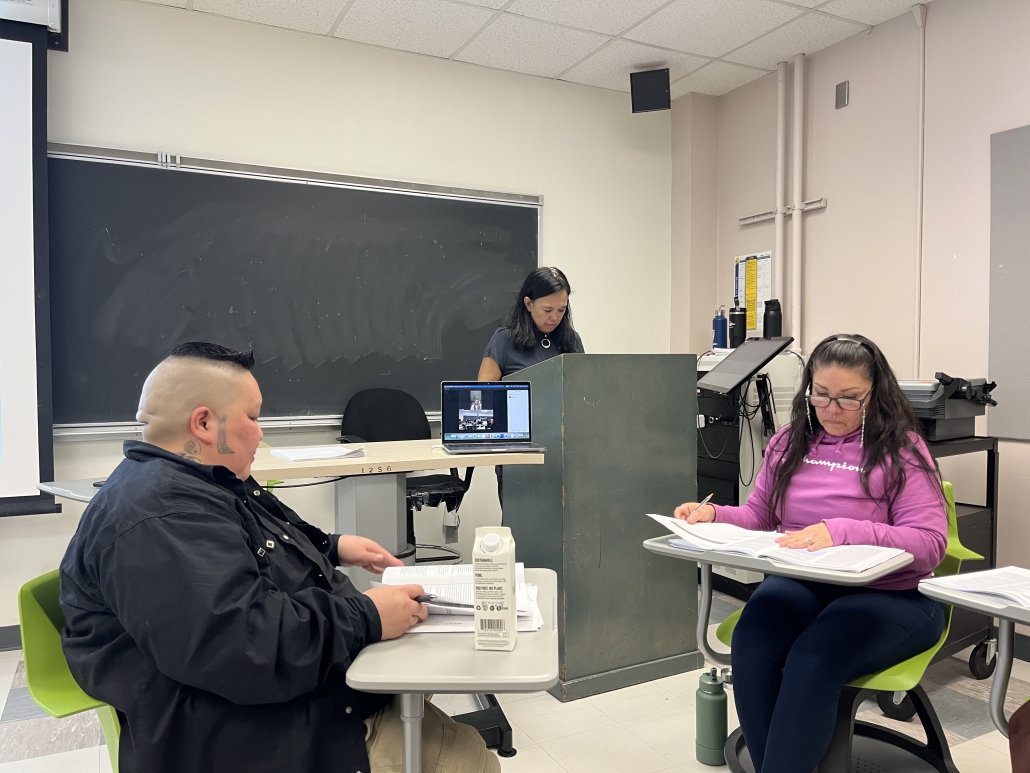
Chouakou “Chewy” Heu (left) and Carmen Lopez (right) analyze course materials during class.
Learning Beyond the Classroom
Fiat Lux and PEP continue to offer courses that take UCLA students into carceral settings.
Dr. Jocelyn Meza, assistant professor-in-residence of psychiatry and biobehavioral sciences in the David Geffen School of Medicine at UCLA, was inspired to teach a course at Victorville Prison thanks to the enriching experience she had in a Fiat Lux course as a UCLA undergraduate.
Ellen Kim, a second-year student majoring in Education and Social Transformation, who took the class emphasized the uniqueness of the learning experience.
“The inside and outside students sat together as classmates,” Kim said. “It was so meaningful to share that space together from that same perspective. We had no access to technology in the prison, which made the conversations feel intentional and more personal.”
For Meza this synergy between students is essential for learning. “If the students are getting along with each other, they’re sharing more ideas,” Meza said. “The more that they share ideas, the more they can think critically about the content. It brought me joy to see the genuine connections happening in this class.”
That lies at the heart of PEP. By expanding access to education and creating spaces where students from vastly different backgrounds can learn together, PEP challenges long-standing assumptions about higher education.
“These courses open doors for people who might never imagine themselves at UCLA,” Lopez said.
For students like Heu, that shift in perspective is life changing.
“My mom says, ‘You must do good to get good luck,’” Heu said. “Now, I’m doing good so I can get good luck. I’m not going to sit in a cell anymore. I choose to learn. I choose to advance my life. And I’m glad for the opportunity here at UCLA.”
 David Esquivel/UCLA
 Vince Bucci