

Two Bruins Selected as Goldwater Scholars
Two UCLA undergraduates have been named recipients of the prestigious Goldwater Scholarship, a nationally competitive award that recognizes sophomores and juniors with exceptional promise as future leaders in STEM research.
This year, just 454 students were selected from more than 5,000 applicants nationwide. The scholarship provides up to $7,500 to support tuition and other educational expenses, helping recipients pursue advanced research and academic training.
Below, the Bruins share what sparked their passion for science and engineering, the research questions that drive them, and how being named a Goldwater Scholar is shaping the next steps in their academic journeys.
Zenya Bian
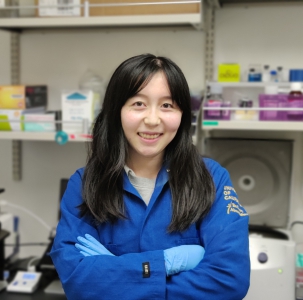
Zenya Bian
Bian is a third-year molecular, cell and developmental biology major with minors in biomedical research and comparative literature. She plans to pursue a Ph.D. in cell and developmental biology with a research focus on embryonic development.
What about your chosen field do you find most interesting?
At its core, developmental biology is all about figuring out how a complex organism arises from a single cell: the fertilized egg. Whether it’s awing and cooing at a newborn baby or watching a seed grow into a plant, I think there is something in all of us that is fascinated with how living beings come to be.
What does winning the Goldwater Scholarship mean to you?
When I arrived at UCLA three years ago, winning this award would have been unimaginable to me. I’m incredibly honored to have been chosen and have never felt more motivated to continue my research journey and improve upon my abilities to conduct science.
How did the Center for Scholarships and Scholar Enrichment support you through the application process?
The CSSE, in particular Rebecca Blustein, continuously provided me with information on the application process and feedback for how to approach the application prompts. Dr. Blustein helped me refine my writing and research experience in my essays.
What are your plans for continuing your academic journey after earning your undergraduate degree?
I will be pursuing a Ph.D. in cell and developmental biology with a research focus on embryonic development. I hope to eventually conduct research in an academic setting by leveraging novel computational tools for developing regenerative therapies.
Anything else you’d like to share?
I’d like to thank my research mentors Drs. Amander Clark, Catherine and Jim Galbraith, and Carrie Spratford; Ph.D. candidate Mark Larsen and all members of the Clark Lab for their support; Ph.D. candidate Lika Balenović and Paria Jahadi for their invaluable feedback.
Samuel Degen
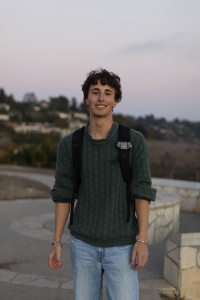
Samuel Degen
Degen is a third-year physics and math double major who plans to pursue a Ph.D. in theoretical physics.
What about your chosen field do you find most interesting?
What excites me most about theoretical physics is the possibility of uncovering deep connections between ideas and mathematical structures that initially seem unrelated. I’m especially fascinated by the way tools developed in one area can unexpectedly transform another, such as in the ways quantum field theory and gravity can inform each other. That unity in physics is striking to me, and I think it can inspire all of us to think more creatively about how we approach difficult problems. Lately, I’ve been intrigued by the way increasingly precise gravitational-wave measurements are pushing theorists to develop new methods and stress-test our most fundamental theoretical tools.
What does winning the Goldwater Scholarship mean to you?
The Goldwater Scholarship feels like an important affirmation of the kind of scientific career I hope to build. It recognizes my research, including work I pursued in Japan on nuclear theory relevant to the long-term development of clean energy, while also reinforcing the importance of communicating clearly across borders and disciplines. Over the long term, I hope to contribute not only through research, but also by helping connect ideas across research communities, institutions, and countries through a shared interest in scientific advancement. It also deepens my commitment to mentorship and to helping create an academic culture in which talented young people can thrive.
How did the Center for Scholarships and Scholar Enrichment support you through the application process?
UCLA’s Goldwater campus representative, Rebecca Blustein, offered thoughtful feedback at every stage of the process. She consistently encouraged me to think carefully about the larger significance of my work, and her guidance helped me communicate the broader trajectory I hope to build from my experiences.
What are your plans for continuing your academic journey after earning your undergraduate degree?
After UCLA, I plan to pursue a Ph.D. in physics and become a professor doing impactful theoretical research, applying quantum field theory to gravity and nuclear physics. I aim to focus on connecting modern theory to experiment, presenting ideas clearly across borders and disciplines, and training the next generation of theorists through inclusive mentorship. By combining these goals, I hope to advocate for sustained support of theoretical physics by helping others see its broader intellectual and societal value.
Anything else you’d like to share?
Many of the questions that excite me most are coming together in one of my current research projects, which adapts methods from quantum field theory to compute gravitational drag forces on black holes with unprecedented precision. That work is part of the international GWSky collaboration, which aims to meet the growing need for high-precision theory in
gravitational-wave science, especially with revolutionary next-generation space-based detectors on the horizon. I’m especially excited by the questions about fundamental particle theory that this problem motivates, along with upcoming opportunities to present this research internationally.
The UCLA Center for Scholarships and Scholar Enrichment empowers students to discover, apply for, and secure scholarships through personalized guidance and support. Learn more here.
 David Esquivel/UCLA